
Le pipeline de contenu IA : générer un mois de médias sociaux en une heure
La création manuelle de contenu sur les réseaux sociaux constitue le plus grand goulot d'étranglement pour le développement des marques. Un pipeline de contenu d'IA correctement structuré élimine entièrement ce goulot d'étranglement en produisant un mois complet de contenu spécifique à la plate-forme et à la marque à partir d'un seul brief.
Clyero Team
Produit et croissance
December 3, 2025
Updated April 4, 2026
Pourquoi la création manuelle de contenu échoue à grande échelle
Une marque publiant de manière cohérente sur trois plateformes – Instagram, LinkedIn et Pinterest – a besoin d'environ 90 éléments de contenu par mois. Chaque pièce nécessite :
- Direction artistique et création d'actifs : 45 à 90 minutes
- Rédaction de copies et de légendes : 20 à 30 minutes
- Redimensionnement pour les formats de plateforme : 15 à 20 minutes
- Planification et publication : 10 à 15 minutes
À 90 pièces par mois, cela représente 125 à 175 heures de travail de production de contenu. Pour une petite équipe, c'est un travail à temps plein. Pour un fondateur solo, c’est structurellement impossible.
Les pipelines de contenu IA résolvent ce problème en regroupant les quatre étapes en une seule exécution automatisée.
Ce que signifie réellement un pipeline de contenu
Un pipeline de contenu n'est pas un outil d'IA unique : il s'agit d'une séquence structurée d'opérations connectées dans laquelle le résultat de chaque étape devient l'entrée de l'étape suivante.
Le pipeline pour une seule publication de produit ressemble à ceci :
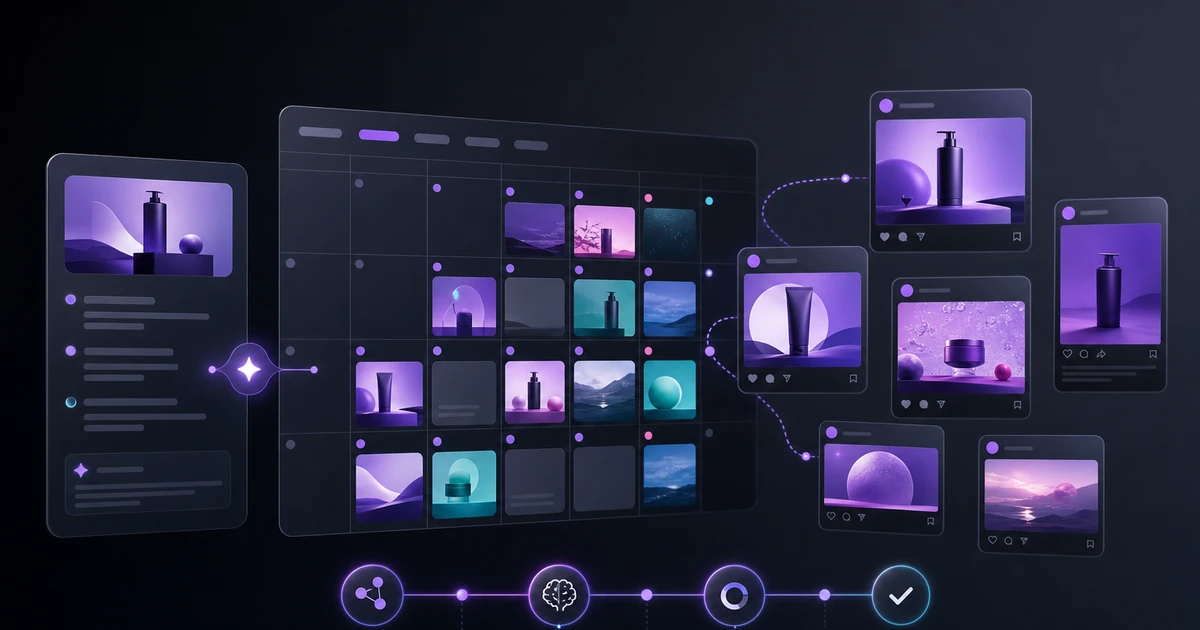
Fiche produit → Génération d'images → Variantes de format → Génération de légendes → PlanificationChaque étape s'exécute automatiquement. Le travail de l'humain consiste à définir le brief au début et à examiner le résultat à la fin.
L'interface canevas de Clyero représente cela sous la forme d'un graphique visuel où les nœuds sont des opérations et les bords sont des flux de données. Vous construisez le pipeline une fois et l'exécutez sur n'importe quelle entrée.
Le pipeline à 5 nœuds qui produit 30 jours de contenu
Nœud 1 : Saisie et extraction
Définissez votre brief de contenu : produit, campagne, ton, public cible et message clé. Pour le contenu axé sur le produit, téléchargez une image ou une URL de produit. Le nœud d'extraction identifie les propriétés visuelles et les attributs clés du produit.
Résultat : résumé de contenu structuré avec contexte du produit
Nœud 2 : Génération visuelle
Le nœud de génération d'image crée votre actif visuel principal : l'image du héros de la campagne. Définir le style (clean product shot, lifestyle, abstrait, saisonnier) et la sélection des modèles (DALL-E, Stable Diffusion, Kling pour la vidéo).
Sortie : 1 à 3 images de héros avec des variations
Nœud 3 : Variantes de format
Le nœud de format prend chaque image de héros et génère simultanément toutes les variantes spécifiques à la plateforme :
- Instagram : flux 1:1 et 4:5, 9:16 Stories/Reels
- LinkedIn : paysage 1,91:1
- Pinterest : portrait 2:3
- Twitter/X : carte 16:9
Sortie : 6 à 8 éléments prêts à être publiés par image de héros
Nœud 4 : Génération de copie
Le nœud de copie utilise un LLM pour générer des légendes pour chaque plateforme, calibrées selon les normes de la plateforme :
- Instagram : 2 à 3 phrases, bloc hashtag, cadence emoji
- LinkedIn : récit professionnel de 3 à 5 phrases, pas d'emoji, pas de hashtag dans le corps
- Pinterest : description optimisée pour le référencement avec des mots-clés
- Twitter/X : moins de 280 caractères, hashtag unique percutant et facultatif
Sortie : légendes spécifiques à la plate-forme avec hashtags
Nœud 5 : Planification
Le nœud de planification regroupe tous les actifs générés dans un calendrier de publication optimisé en fonction des fenêtres d'engagement maximales de votre audience. Un clic programme tout le mois.
Sortie : calendrier publié sur toutes les plateformes
Exécution du pipeline complet : une répartition temporelle
Pour une marque avec 8 produits héros et 4 plateformes :
| Étape | Temps |
|---|---|
| Brève contribution pour les 8 produits | 12 minutes |
| Génération d'images parallèles (les 8) | 8 minutes |
| Variantes de format (toutes plateformes) | 3 minutes |
| Génération de copie (tous les produits × plateformes) | 5 minutes |
| Révision et édition légère | 15 minutes |
| Planification | 5 minutes |
| Total | 48 minutes |
Cela produit 8 images de héros × 7 variantes de format = 56 ressources spécifiques à la plate-forme plus 32 variantes de légende — couvrant quatre semaines de publication quotidienne sur quatre plates-formes.
Mesurer la qualité de sortie du pipeline
La principale mesure d’un pipeline de contenu n’est pas la vitesse, mais le taux de conversion. Piste :
- Taux d'engagement par publication (les publications générées par l'IA fonctionnent-elles de manière comparable aux publications manuelles ?)
- Taux de clics pour les publications sur les produits (l'IA copie-t-elle l'action ?)
- Temps gagné (heures récupérées par mois)
- Cohérence de la publication (respectez-vous votre calendrier de publication ?)
La plupart des marques constatent une parité d'engagement avec le contenu manuel au cours des deux premières semaines, alors qu'elles affinent les paramètres de leur kit de marque et leurs modèles d'invite. Après six semaines, le contenu généré par l’IA surpasse généralement le contenu manuel en raison d’une fréquence de publication plus élevée et de tests A/B cohérents.
Erreurs courantes dans la configuration du pipeline de contenu IA
Dépendance excessive aux styles par défaut : le plus grand écart de qualité vient de l'utilisation de styles d'IA génériques plutôt que de la configuration correcte de votre kit de marque. Passez les 30 premières minutes à définir le bon style visuel – tout ce qui suit s’aggrave.
Générer sans une brève structure : des entrées vagues produisent des sorties vagues. Plus votre brief est spécifique (produit spécifique, public spécifique, avantage spécifique), meilleur est le résultat.
Le traiter comme une exécution unique : la valeur se compose avec l'itération. Exécutez le pipeline chaque semaine, analysez ce qui a été effectué et réinjectez ces données comme contexte pour la prochaine exécution.
Les marques obtenant le retour sur investissement le plus élevé grâce aux pipelines de contenu IA les traitent comme un processus de production systématique et non comme une automatisation ponctuelle.
Related Clyero workflows
Continue with practical workflows for product visuals, video, ad creative, and marketplace content.
Frequently Asked Questions
Qu'est-ce qu'un pipeline de contenu IA ?
Comment maintenir la cohérence de la marque dans le contenu généré par l’IA ?
Les pipelines de contenu IA peuvent-ils gérer automatiquement les formats spécifiques à la plate-forme ?
Quels types de contenu un pipeline d’IA peut-il produire ?
Try it free
Build your first AI content pipeline
Turn one product photo into a full content system — images, videos, captions, and posts — in minutes.
Start for freeClyero Team
Produit et croissance
Writing about AI content creation, e-commerce automation, and the future of brand storytelling at Clyero.
Related Articles
Une séance photo produit, 60 ressources de contenu : le flux de travail de réutilisation
La plupart des marques de commerce électronique génèrent beaucoup moins de contenu à partir de chaque séance photo de produit que ne le permet la matière première. Un flux de travail structuré de réutilisation de l'IA extrait le volume maximal d'actifs de chaque image de produit, transformant une photographie en 60 éléments de contenu prêts à être produits pour la production, sur tous les formats, plates-formes et canaux.
February 20, 2026
Une séance photo produit, 60 ressources de contenu : le flux de travail de réutilisation
La plupart des marques de commerce électronique génèrent beaucoup moins de contenu à partir de chaque séance photo de produit que ne le permet la matière première. Un flux de travail structuré de réutilisation de l'IA extrait le volume maximal d'actifs de chaque image de produit, transformant une photographie en 60 éléments de contenu prêts à être produits pour la production, sur tous les formats, plates-formes et canaux.
February 20, 2026
Comment générer plus de 30 ressources de médias sociaux à partir d'une seule image de produit
Une photo de produit contient tout ce dont vous avez besoin pour produire un mois complet de contenu social multiplateforme. Le flux de travail est un pipeline, et non une séquence de tâches individuelles, et le volume de sortie est considérablement plus élevé que ce à quoi s'attendent la plupart des équipes de contenu.
January 8, 2026