
How DTC Brands Launch Across All Channels Simultaneously with AI
Direct-to-consumer brands that activate all channels on launch day generate higher initial sales velocity and better algorithmic performance than brands that stage rollout by channel. AI content pipelines make simultaneous multichannel launch operationally feasible for teams of any size.
Clyero Team
Product & Growth
March 1, 2026
Updated April 4, 2026
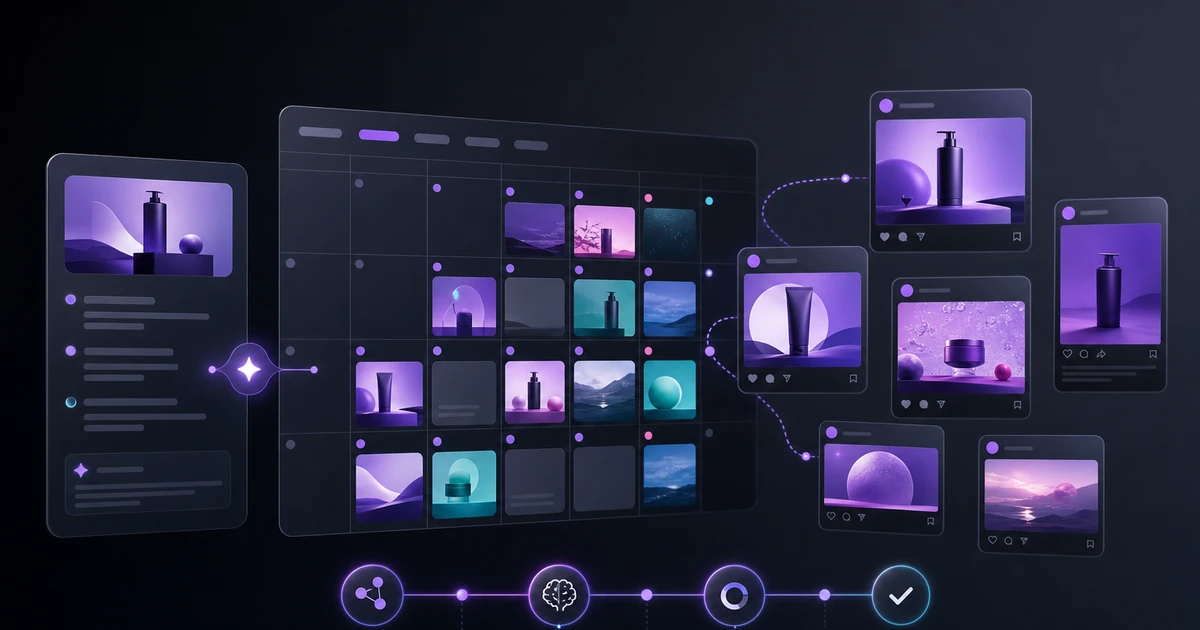
The conventional DTC launch playbook — start with the website, add Instagram, eventually set up Amazon, eventually try paid — reflects the content production constraints of pre-AI workflows. Creating a full creative set for every channel took weeks, so channels were activated sequentially. AI generation removes this constraint entirely.
A DTC brand with a structured AI pipeline can produce launch-ready creative for every channel in a single day, and activate all of them on the same morning.
Why Simultaneous Launch Outperforms Sequential Rollout
Sequential channel rollout has an invisible cost that most brands do not measure: momentum diffusion. When a brand launches on Instagram but not Amazon, and on email but not paid, the initial excitement is spread across time rather than concentrated. Customers who discover the product on launch day and want to buy on Amazon find an empty or bare listing. Customers who click a social ad find no social proof yet because the brand account launched the week before.
Simultaneous launch concentrates all signals — traffic, purchases, engagement, reviews — into the same 24–72 hour window. This is when algorithmic systems (Amazon ranking, Instagram Explore, TikTok FYP) are most sensitive to new product signals.
The Channel Requirements Matrix
Each channel requires specific creative assets. Mapping these before content generation prevents gaps on launch day.
| Channel | Required assets |
|---|---|
| Shopify/DTC website | 5–8 listing images, hero banner, product description |
| Amazon | Main image, 6 secondary images, A+ header, bullets |
| 3 feed posts (1:1 or 4:5), 2 Stories (9:16), 1 Reel (9:16 video) | |
| TikTok | 1–2 product videos (9:16, 15–30s) |
| 3 pin images (2:3), descriptions | |
| Email (launch) | Header image (600×300), subject line, product copy |
| Facebook/Meta ads | 2 ad creatives (1:1 and 4:5), primary text, headline |
| Google ads | Display banners (300×250, 728×90), responsive image set |
Total visual assets: approximately 30–40. Total copy pieces: approximately 15–20.
The Pre-Launch Production Timeline
T-7 days: Content brief and pipeline setup
Write the product brief: product name, category, key features (3–5), target customer, brand voice, primary use case. This brief is the shared input for all generation tasks.
Load the brief into Clyero's pipeline. Configure the brand kit to match your visual standards. Define the output scenarios for each channel.
T-5 days: Generate all visual assets
Run the full generation pipeline. Review outputs and regenerate any that miss quality or brand standards. This typically takes one working day.
T-3 days: Generate copy and finalize
Generate all copy assets using the same product brief. Review for tone, accuracy, and platform fit. Draft the email campaign and set it to send at launch time.
T-1 day: Upload and schedule
Upload all assets to each platform. Schedule social posts to publish at launch time. Upload listing images and A+ content to Amazon (note: A+ content review takes 7–14 days — submit earlier if possible, with a temporary version for launch day). Configure ad campaigns to start at launch.
T=0: All channels live simultaneously
Managing Content Production at Scale
For DTC brands launching multiple products per month, the challenge shifts from single-launch execution to pipeline efficiency. The goal is reducing the per-product content production time progressively:
- First launch with a new pipeline: 8–12 hours total (setup + generation + review)
- Second launch with same pipeline: 3–4 hours (generation + review)
- Tenth launch with established pipeline: 1–2 hours (generation + expedited review)
The pipeline compounds in value the more it is used. Brand kit calibration improves. Output consistency increases. Review time decreases because outputs are predictably on-brand.
What AI Cannot Replace in a DTC Launch
AI pipelines produce the creative volume — but launch success still depends on:
Founder story and authentic UGC: The content that drives early social trust is often raw, personal, and hand-created. AI-generated polished content and authentic founder content are complementary, not competing.
Strategic timing: AI produces the assets but cannot decide when to launch relative to seasonal demand, competitor activity, or platform algorithm cycles.
Community seeding: Pre-launch community building, influencer seeding, and early access programs are human-driven and not replaceable by content automation.
The winning DTC launch combines AI-powered creative volume with human-driven community and strategy.
Related Clyero workflows
Continue with practical workflows for product visuals, video, ad creative, and marketplace content.
Frequently Asked Questions
Why does multichannel launch day matter for DTC brands?
What is the minimum content set needed to launch a DTC product across all channels?
Try it free
Build your first AI content pipeline
Turn one product photo into a full content system — images, videos, captions, and posts — in minutes.
Start for freeClyero Team
Product & Growth
Writing about AI content creation, e-commerce automation, and the future of brand storytelling at Clyero.
Related Articles
Visual Brand Consistency at Scale: How AI Keeps Your Creative Output Coherent
As ecommerce brands scale their content output with AI generation, visual coherence becomes the hardest quality to maintain. Brands that solve it build a visual fingerprint that drives recognition and trust. Brands that do not produce content that looks generated and generic.
March 10, 2026
Visual Brand Consistency at Scale: How AI Keeps Your Creative Output Coherent
As ecommerce brands scale their content output with AI generation, visual coherence becomes the hardest quality to maintain. Brands that solve it build a visual fingerprint that drives recognition and trust. Brands that do not produce content that looks generated and generic.
March 10, 2026
How to Maintain Brand Consistency Across AI-Generated Ecommerce Content
Brand consistency is not about using your logo everywhere — it is about maintaining recognizable visual and tonal coherence across every customer touchpoint. AI generation makes consistency easier to achieve at scale if you structure it correctly, and much harder to maintain if you do not.
December 18, 2025